Integrating Gender in Water Management
Projects
Nadia Aziz[1]
Abstract:
History witnessed man and woman
equality in human rights and responsibilities. They both ruled
Despite considerable advances in
gender equality in recent decades, gender discrimination in most countries
remains pervasive in many dimension of life. Gender gaps are widespread in
access to and control of resources. In order to reduce the gender gap, positive
reform in favor of women is needed; more policy emphasis should be put on
women’s needs. Rural women play a predominant role in food production cycle. To
ensure a viable and sustainable irrigation scheme, it is therefore; necessary
to take into account the increased demand for women’s labor in irrigation and
agriculture production. The irrigation projects should have clear objectives,
be demand driven, consultative, and participatory and co-managed by the
beneficiaries supporting rural women in their productive activities. Policies
and programmes should adequately address the needs of rural women as for men.
Men’s gender awareness and commitments are indispensable for rural women’s
development in particular.
The author
presents in the paper a general review of the most important analysis made in
this field up to date in
1. Introduction:
The IIP has innovated several measures to raise the
performance of the irrigation distribution networks and on-farm practices in
The Fayoum is an old irrigation area, located in a huge
depression west of the
2. Objectives of the study:
The overall goal of this paper is to
enhance and activate the role of women in irrigation development projects and
indicate its impact on the household and family standard of living; to point
out the challenges facing women participation and suggest recommended
strategies for future actions.
In
order to achieve this objective; two case studies are illustrated and their
results are analyzed and discussed to explore the degree of success and
consequently extracts the points of strength and weakness.
As for the IIP, the following points are considered:
·
Identify and
determine the role of rural women in IIP regarding landholding size.
·
Examine
rural women's awareness and perception about IIP objectives and to the limited
water resources in
·
Analyze
the significance of women's participation and its effect on their families'
welfare. Also, their tendency to join WUA’s
·
Identify the
role of rural woman in decision making.-Measure the changes resulted of using
improved irrigation on agricultural production and reduce irrigation costs from
the point of view of the rural woman respondents.
·
Provide
guidelines for implementing and financing agencies, for effectively involving
women in future irrigation development projects.
With respect to FWMP, the following
points are considered:
·
Identify
reasons female-headed households manage smaller farms than their male
colleagues, and hence obtain lower yields than men.
·
Investigate
about water distribution fairness at tertiary, secondary and primary level.
·
Search
for the following: a- "female farmers have problems in approaching the water management officials".
b-"Women are more responsible for water pollution than men".
C-”only women from influential families and female officials can speak at public
meetings” d-"leaders of WB pay little attention to
the interest of small farmers and female headed
households"
3. Research Methodology:
It deemed important to indicate that the basic elements for sustainable water
based and irrigation development projects are; water, human and the
environment.
Human
Water Environment Environment
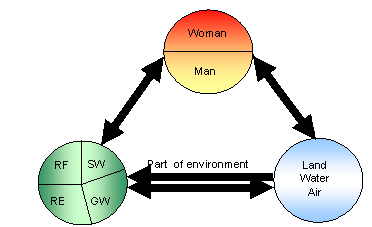
Fig. (1) Water, Human, Environment
Relationship.
Water is in fact, part of the
environment and the human element is affected by and affecting on the
environment. Such triangular relationship represents the strong interaction
between the three basic elements for development on earth. However, to sustain
future development, optimum use of such combination without influencing the
environmental balance must be secured. This indeed what requires strict rules,
knowledge and experiences, continuous monitoring and assessment, use of logic
indicators to measure the success or failure. According to this understanding,
one has to differentiate between natural constraints due to resources
limitation and /or adversely affecting the environment, and man made imposed
constraints on the efficient involvement of the whole community.
Regarding
IIP case study project the data and information were collected through two sets
of questionnaires:
The study was conducted in
The approach with respect to FWMP little bit different:
The
explorative study conducted in the Fayoum area about woman and water management
is carried out in the command area of Senouris primary canal. A purposive
sampling method has been used to select 3 secondary or branch canals in the
head, middle and tail of Senouris. The assumption made was that the branch
canals in these reaches have different water duties, which can affect the
female headed households in their on-farm water management strategies. Data
collected about the internal water distribution during the summer season 2003
shows that the assumption was right, and that the selected branch canal did not
have extreme high or low water duties. The surveyors collaborated with the
Water Board WB leaders to select randomly 3 mesqas located respectively in the
head middle and tail reach of the branch canal. For each mesqa the surveyors
and the leaders prepared a list of de-jure and de-facto female-headed
households. Women heads of de-facto were visited and asked to organize meetings
with other respondents. Questionnaire was used with explanation of the survey
objective and gender aspects of water management. Some women were interviewed
individually using the semi-structured questionnaire.
4. Analysis of Results:
The outcome
of the two field survey studies revealed some common results and others unique
to each case study.
4-1The
common ones may be summarized as follows:
- Both men and women are involved in irrigation and
agriculture. Female farmers contribute relatively more labor to the water
management process than controling management of resources itself, decision-making
and planning.
- Women know when to irrigate, and they are aware of
irrigation and drainage problems.
·
Women
have information about the project benefits and that it focuses on
environmental protection, channel cleaning and saving irrigation time and
efforts. But they have no access to modern technology application and training.
·
Women are
willing to participate in addressing issues such as: pitching and building
walls on sides to protect their children.
- Many women cannot own
land, and those who do generally command smaller land holdings than men,
have less access to machinery, fertilizer, extension services. Female
farmers are left with less fertile land, which makes them to do more work
in addition to their family work (double burden).
- Disparities inhibit women’s ability to
participate in development and to attain higher living standards for their
families.
- Lack of property
rights, since without land as collateral they cannot obtain loans to
purchase seeds, fertilizers…etc.
- Women suffer the
disadvantage in receiving services
because extension workers are male. They are also directed towards crops
for subsistence economy, and not consulted in the resources management
process or express their problems.
- Although women have
direct contact with authority, water resources management neglects linking
the quality of water to health, environment and economic development.
- Social and cultural
norms have a strong impact on women participation. In under developed countries,
women do not automatically participate in new projects which are designed
to meet technical aspects rather than social.
- Donors and
governments often use the term gender when addressing different needs with
respect to water resources, they usually mean women which make men
provoked and reluctant to let their wives participate
- Engineers rarely
examine the pattern of needs of different groups of potential users and consider
this information when designing the system. It is usually assumed that
social group will change their habits of interaction to accommodate and
take advantage of available water.
4-2
Experiences from IIP revealed the following outcomes;
- Women's participation varied according to the
project' phase. Results showed that women were not direct beneficiaries in
the project formulation. In introducing the project objectives in the
field, some women were accessible and showed interest to know about the
project. In forming the WUA's it was not culturally accepted for women to
attend the meetings in men’s houses and women did not participate in the
initial meetings. Since they did not participate in any WUA activities,
they are not members of the WUA's.
- The age and marital status influence women's
participation. Survey showed that the project information was explained to
56% of the women over 40 years and to 26% of women under 40 during the
introductory phase. Women farmers participate more than the house women do,
since they have more time to devote. Socially it is acceptable for older
women in what is traditionally considered as male activities. In case of
widowed women, they are the heads of their households and in many cases,
they have to manage their households and farms.
- Great majority of women know enough about the IIP
new system, but their knowledge come from their husbands neighbors…etc.
- Women own land in the project command areas, they
never join the WUA's. They ask their husbands or sons to respond to
project's men staff. In addition, their access to water resources is often
strictly controlled by their husbands and indirectly by cultures norms and
practices. For woman to be active member in WUA’s or a WB she should
attend meetings with men: -Husbands do not agree that they attend meetings
at night/ - too far from homes/ -They are not trained to act as female
representatives. The participation of influential women is accepted and
encourages other women to participate.
- Poverty and illiteracy have strong impact on the
management of the farms. Due to the limited participation and the high
illiteracy rate of the respondent women , it was hard to detect any
relationship between women participation and education, 75% of the women
interviewed had no formal school education.
- Women's participation influenced by social norms.
In
- Men recognized the increase of the income, yield
and saving of time and labor more than women did. However, women
recognized the positive environmental impact more than men did. Women
farmers and widows have more benefits than married women and house women. In
addition, 94% of the women pointed out that they benefited from the saved
time and labor in the household and child care activities, 20% used it in
more farm management. Compared to men, 87% of them used the saved time in
more farm management.
4-3 The findings from the FWMP are
summarized in the following;
- Women in Fayoum control 17% of the lands, and about
20% of the farming households are female headed. However, female-headed
farming households control smaller holdings than male. About 60% of the
farms managed by respondents are less than 0.5 feddan and 22% of the farms
between 0.5 and 1 feddan. Farms larger than 1 feddan, are managed by 18%
respondents. 7.5% of the respondents managed farms between 1 and 3 feddans,
4 % managed 4.5 feddans and 7.5% managed farms larger than 10 feddans. About
15% of the respondents are married and their husbands work outside Fayoum
governorate. They do not commute and therefore the households are de-facto female-headed. The other 85% are widows
and they are middle and old aged women.
- Women respondents, mentioned that they manage
smaller farms than male due to Islamic inheritance systems (female receives
only 50% of the male share). In addition, they adjust the cropping pattern
and farm operations according to their cash, labor and information constraints.
Almost 74% of the respondents consider that they have more problems to
manage their fields. They also plant food crops for family needs. About 85.4%
of the respondents confirmed obtaining lower yields. Hence, they organize
the minor farm operation with family labor.
- The WB work towards a fairer water distribution and
the female farmers expressed an interest to contribute to that effort,
since they have clear opinion about the irrigation distribution system. About
92% of them, considered that they have more problems in solving water
management than males due to social constraints that female farmers have
in approaching water management officials, leaders of the water users
group, village heads.
- Women opinions regarding water pollution and its
causes are changing in the urban environment. Women in the area held the
local government responsible for developing an effective and affordable
waste disposal system. They consider that the stakeholders jointly develop
action plans to reduce pollution of water and canals.
- Women’s participation in the water users
organizations is restricted to the branch and primary canal level. Men
lead almost exclusively the local irrigation networks, since they are the
leaders of its rotation operations. The project has encouraged female
leaders to participate in the newly established WUAs at the canal level.
Only two women managing large farms have been elected to represent their
mesqas. Female farmers are
interested in the WB efforts in integrated water management, however
sometimes they cannot participate in evening meetings.
5. Conclusion and Recommendations:
I.
Conclusion:
The
literature review showed that, in general, cultural habits, attitudes towards
woman in the communities of under developed countries as well as institutional
and legal norms are behind the backward standards of women more than men are.
The two specific case studies, which were considered in the paper, IIP and
FWMP, are both step forward to correct old believes and understandings about
the important role of women in water based development projects. However, such
step must be followed by other continuous reform programme to raise the women
status in the rural community and structure a solid strategy for institutional
and legal reform aiming at more women education, legal representation , full
participation and motivation to preserve her civil political rights, although lack
of opportunities create competition in poor countries. The author noticed an important remark in both
cases. There was no gender consideration in feasibility studies, which is the
normal procedure; that field study must be stage one and must precede project
implementation and not vice versa.
The most
dominant conclusion could be summarized in the following points;
a.
There is
a clear shortage in the field survey to explore the real problems and realistic
reasons for the absence of the rural women and their active role, which
significantly differ with respect to geographic locations and local community
habits in the south and north of
b.
Project
managers and some legal authorities always keep low profile about engaging
rural woman at the different phases of water related projects.
c.
There is
little attention given to girls education, rural women awareness, political
representation, equal opportunities and health care.
d.
The
absence of NGO’s to protect rural women rights and play an advisory role to
introduce rural women as members and partners on the WUA’s and WB in order to
assure their equal participation in water management.
e.
The
existence of some barriers, social, economic, political, legal….etc; inhibit
the efficient involvement of rural women in the water projects and
environmental protection schemes.
II. Recommendations:
Gender issues are strategic issues in the development
process, if not resolved it may turn to sever community problems that, in turn
if neglected it might turn to civil crisis. The author, according to
experiences and recognition of the gender problem roots in
a.
There
must be an accurate and updated gender database at the village, town and
governorate’ big city levels. The designed formats for each level may slightly
differ according to the nature of the labor market (housewife….administrator.).
Data and information collected focused on water should include age, education,
social status, skills, nature of present occupation experience, marital status,
family status…etc.
b.
The labor
offices and statistics must have access to the database through networking in
order to link it with the unemployment situation at all levels and to cooperate
with the NGO’s representatives.
c.
These
data and information should be analyzed by gender experts and consultants to
develop plans and actions proposed to the ministries and stakeholder concerned,
meantime the points of strength and weakness must be clearly highlighted and
categorized in order to apply proper mitigation.
d.
It is
highly recommended to create “ Gender affairs Boards”
related to water projects from the inhabitants themselves at the
village level to follow up proposed plans, actions, help resolve gender
problems with governmental and non-governmental organizations. Also, the civil
boards will ensure that labor laws, health and environmental needs, services
including education…. etc are provided on equal base.
e.
Derive
certain measuring criteria to monitor the suggested actions.
The proposed
indicators may include:
1.Percentage of girls to boy’s schools, in the past 10
years, at present and targeted after 10 years. The trend is the indicator at
different age group (education index).
2.The percentage number of patients (M to F) recorded visiting
the village and town hospitals and clinics to be categorized according to water
born and non-water born diseases (health index), to distinguish between women
farm labors and non-farmers using a valid indicator to health.
3.The number of economic dependent and non-dependent rural
women at the village and town levels must be recorded. The indicator derived is
the percentage of women landowners (non-dependent) to the unemployed women (men
dependent) which can be used as economic indicator (economic index).
4.The percentage of active women willing to participate to
the total rural women in community this reflects the social indicator of
specific location (social index) assuming that there are no other constraints.
f. In order to
integrate gender organizations efforts and disseminate knowledge, information
and experiences in the field of water based projects, mainly irrigation,
domestic and sanitation, where the author suggests focusing on training of
trainers (TOT). Therefore, training centers, under the umbrella of the
“National Council for Women” in
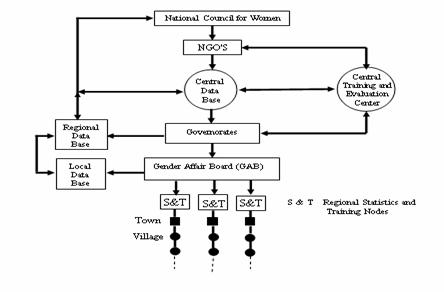
Proposed Schematic Organizational
Chart for Integrating Gender in Development System
In brief
the author would like to stress on three main points:
I.
Provide education II. Build
self-confidence III. Use common
technical language
Support Documents:
-Promotion of Women’s
participation in Water Resources Development, report of the seminar-
-The Extent and
Impact of Women Participation in the Irrigation Improvement Project in
-Mainstreaming Gender in Water Resources Management Why and How, The World Vision Process.
-On the Improvement of
the On-Farm Irrigation Management and Practices in
-Sourcebook for
Gender Issues at the Policy Level in the Water and Sanitation Sector,
UNDP-World Bank Water and Sanitation Program , Water Supply and Sanitation
Collaborative Council.
-Developing the
skills and participation of women irrigators. Experiences from smallholder
irrigation in Sub-Saharan
-Knowledge o Rural
Women Regarding the Importance of IIP, by Dr. Shukry M. Badran, Dr. Mahmoud S. Agamia,
-Fayoum Water
Management Project Final Phase, Technical Report 32,by DHV Agriculture &
Natural Resources, 2003.